A digital twin, not another list.
Navigate ownership, networking, storage, and runtime dependencies as one explorable 3D topology.
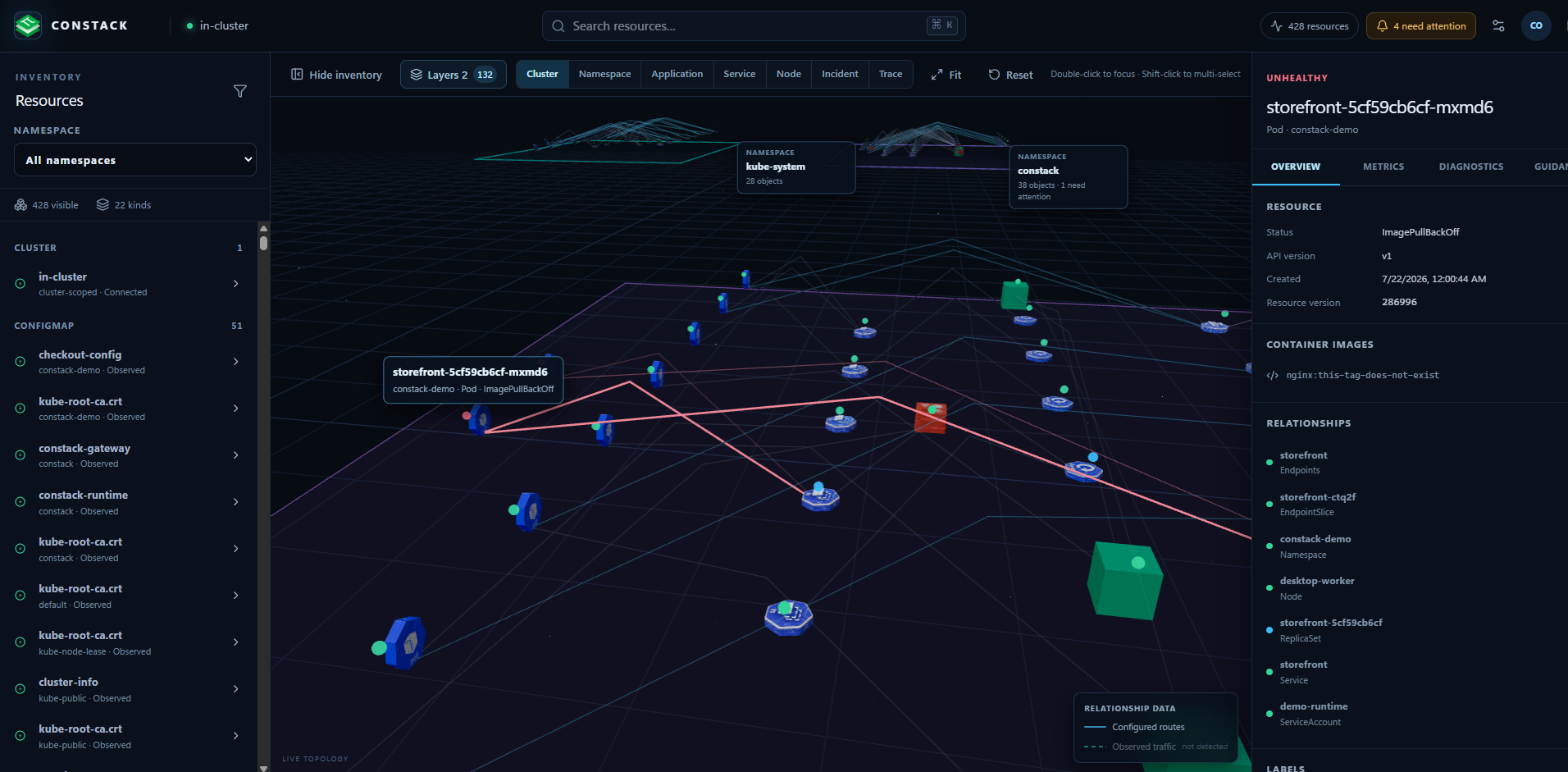
Constack turns Kubernetes resources into a live 3D digital twin—so you can trace relationships, investigate incidents, and operate with full context.
Self-hosted in your cluster. No account required.
One connected view
Stop reconstructing incidents across tabs and dashboards. Constack brings live resource state, relationships, telemetry, events, and diagnostics into the same spatial model.
Navigate ownership, networking, storage, and runtime dependencies as one explorable 3D topology.
Kubernetes watches and incremental WebSocket patches keep the scene current without repeatedly loading the entire graph.
Investigate in context
Select any resource and move naturally from its place in the topology to the evidence behind its current state.
Move between resource details, metrics, logs, events, relationships, and history without losing what you selected.
Configured routes and observed traffic remain visually distinct, so the map never invents certainty.
Surface local findings from resource status and events before sending any context to an external system.
Filter by namespace, kind, health, or search, then switch between cluster and resource-focused layers.
A normalized observability adapter supports capability discovery across metrics, logs, traces, health, and traffic.
Safety by architecture
Constack separates observation, analysis, and action into explicit boundaries. Safety is not a setting layered on later—it is part of how the system is assembled.
Discovery runs with read-only Kubernetes access. Write permissions live in a separate, optional worker.
Secrets, ConfigMap contents, service-account tokens, raw manifests, and literal environment values are removed at the boundary.
Every optional mutation requires a short-lived preview, explicit confirmation, fresh resource checks, and an audit trail.
External analysis is recommendation-only, tokenless, and structurally isolated from Kubernetes actions.
Under the hood
A simple data path keeps Kubernetes authoritative while the interface stays fast, current, and understandable.
A read-only discovery worker follows Kubernetes API changes as they happen.
The topology engine resolves ownership, routing, storage, and runtime relationships.
Sequence-checked patches move through Redis and WebSockets instead of full reloads.
The web console renders the cluster as a responsive, deterministic 3D scene.
Run it yourself
Install the evaluation stack with Helm, forward the service, and open the console. Production deployments can use external MySQL and Redis services.
helm upgrade --install constack oci://ghcr.io/constack-co/charts/constack --version 0.1.0 --namespace constack --create-namespace --waitchart installed
workloads ready
read-only discovery connected
kubectl port-forward service/constack 3000:80 -n constackExplore the source, inspect the architecture, and bring your Kubernetes cluster into view.
Explore Constack on GitHub